Solar Guides
Solar Panels for Bristol Homes: Costs, Grants and Installation
What you'll pay for solar panels in Bristol, how much you'll save, and which grants can cut the upfront cost.
- Typical 4 kW system: £5,000-£7,000 installed
- Bristol homes generate around 3,400-3,600 kWh/year
- Payback period: 8-12 years at current energy prices
- Grants: 0% VAT, Smart Export Guarantee, check council schemes
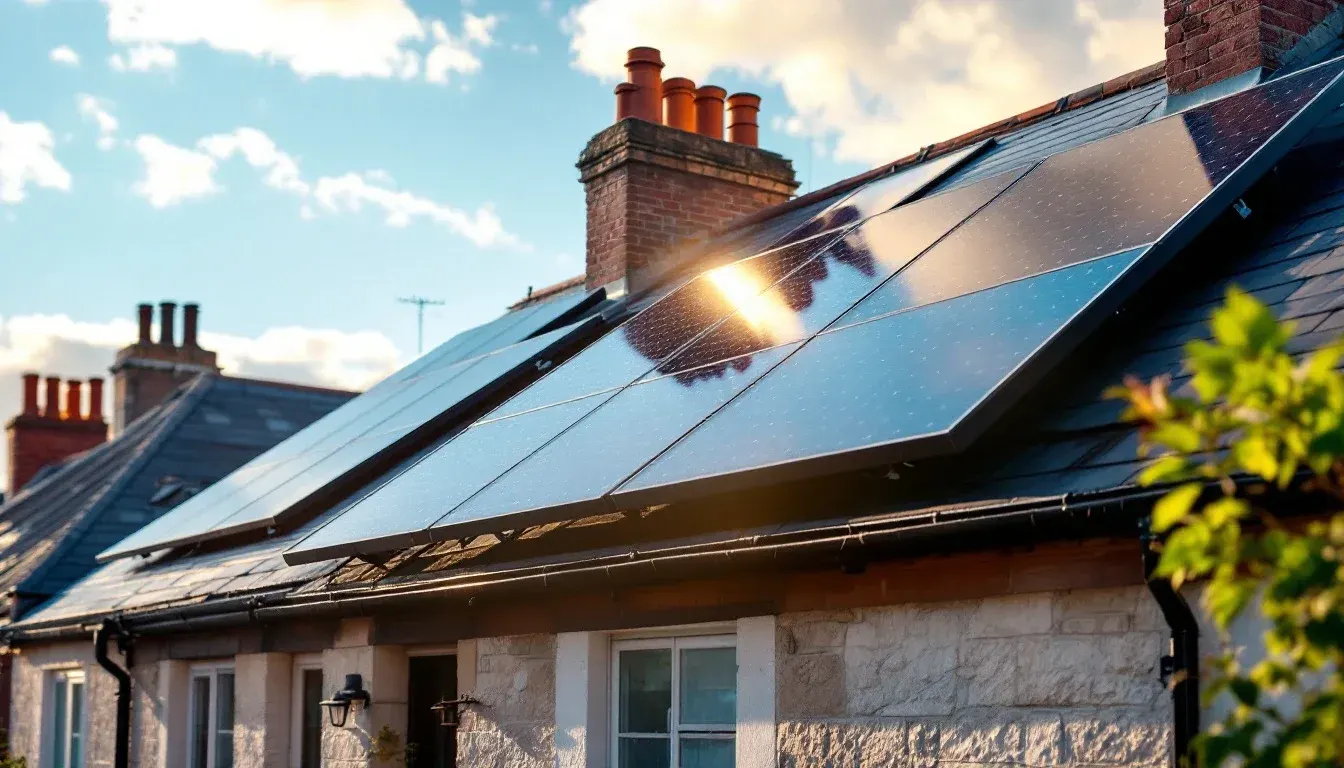
Solar panels fitted to a period terrace roof. Bristol's older housing stock, with roof pitches around 30-40 degrees, is well suited to solar generation.
Contents
- How much do solar panels cost in Bristol?
- How much electricity will solar panels generate in Bristol?
- What grants are available for Bristol solar panel installations?
- How long does it take for solar panels to pay back in Bristol?
- How do you find an MCS-certified installer in Bristol?
- Do solar panels work on Bristol's older housing stock?
- Should you add battery storage to a Bristol solar panel system?
- Frequently asked questions
- Related guides
- Typical 4 kW system
- £5,000-£7,000 installed.
- Bristol annual generation (4 kW system)
- 3,400-3,600 kWh per year.
- Payback period
- 8-12 years at current energy prices.
- VAT saving
- 0% VAT saves around £1,000-£1,400 on a typical system.
- 25-year lifetime savings
- Typically £15,000-£20,000.
How much do solar panels cost in Bristol?
A typical domestic solar panel installation in Bristol costs between £5,000 and £7,000 for a 4 kW system covering around 16-20 panels. Larger 6 kW systems (24-30 panels) typically cost £7,000-£10,000 installed (Energy Saving Trust, May 20261).
These figures include panels, inverter, mounting hardware, electrical work, scaffolding (if required), and MCS certification. Prices can vary depending on panel brand, roof complexity, and whether you add battery storage. Battery systems add £3,000-£6,000 to the total cost.
Since January 2024, all solar panel installations on residential properties have been charged 0% VAT, which saves around £1,000-£1,400 on a typical 4 kW system compared to the previous 5% rate (HMRC Notice 708/6, updated April 20262).
How much electricity will solar panels generate in Bristol?
Bristol receives around 3.0 kWh/m²/day of solar irradiance on average across the year (Met Office UK Solar Resource Dataset, 20253). That puts Bristol slightly above the UK average due to its southwesterly location.
A typical 4 kW system in Bristol will generate around 3,400-3,600 kWh per year, assuming south-facing panels at a 35-degree pitch with no shading. East- or west-facing panels generate around 80-85% of that figure. A north-facing roof is not recommended for solar panels, as output drops to around 50-60% of optimal.
Generation varies by season. In Bristol, solar panels produce roughly 60-70% of their annual output between April and September, with peak generation in May and June. Winter months (November to February) contribute only around 15-20% of annual generation.
A typical UK household uses around 2,700-4,100 kWh of electricity per year (Ofgem, 20264). A 4 kW solar system in Bristol can therefore cover 70-80% of a household's annual electricity needs, though actual self-consumption depends on when you use electricity relative to when panels generate it.
What grants are available for Bristol solar panel installations?
As of May 2026, there are no direct upfront grants for solar panels available to most Bristol homeowners. However, several mechanisms reduce the effective cost:
- 0% VAT: All solar panel installations on residential properties are zero-rated for VAT, saving around £1,000-£1,400 on a typical system.
- Smart Export Guarantee (SEG): Licensed electricity suppliers must pay you for surplus electricity you export to the grid. SEG rates vary by supplier but range from 4p to 15p per kWh as of May 2026 (Ofgem SEG data, May 20265). A typical Bristol household exports 30-50% of solar generation, earning £100-£250 per year depending on the tariff.
- Bristol City Council schemes: The council occasionally runs grant or loan schemes for low-income households or specific neighborhoods. Check the Bristol City Council energy advice page6 for current schemes.
- West of England Combined Authority: WECA has funded retrofit schemes in the past. Check their website7 for active programs.
Solar panels are not currently eligible for the ECO4 scheme, which focuses on insulation and heating measures for low-income and fuel-poor households.
How long does it take for solar panels to pay back in Bristol?
Payback periods depend on system cost, energy prices, self-consumption, and export earnings. As of May 2026, with electricity prices around 25p/kWh under the energy price cap and typical SEG export rates of 4-7p/kWh, a 4 kW system costing £6,000 in Bristol will typically pay back in 8-12 years.
Factors that shorten payback:
- Higher self-consumption (using more solar electricity yourself rather than exporting it)
- Higher export tariff (some suppliers offer 10-15p/kWh for SEG)
- Rising electricity prices (every 1p/kWh increase in grid prices saves around £40/year on a 4 kW system)
- Adding battery storage (increases upfront cost but allows you to store and use more of your own generation)
After the system pays back, it continues to save money. Over a 25-year panel lifespan, total savings typically exceed £15,000-£20,000, depending on electricity price trends.
How do you find an MCS-certified installer in Bristol?
Only use an MCS-certified installer. MCS (Microgeneration Certification Scheme) is the quality standard for small-scale renewable energy installations in the UK. MCS certification is required to access the Smart Export Guarantee and ensures the installer meets technical and consumer protection standards (MCS website8).
To find MCS-certified solar installers in Bristol:
- Visit the MCS installer search9 and enter your postcode.
- Get quotes from at least three installers. Ask for a breakdown of costs, panel specifications, expected annual generation, and warranty terms.
- Check reviews on Trustpilot, Checkatrade, or local community forums.
- Ask whether the quote includes scaffolding, electrical upgrades, and MCS certification fees.
Be wary of installers offering "limited time" discounts or pressure to sign on the day. Reputable installers will give you time to compare quotes and check details.
Do solar panels work on Bristol's older housing stock?
Bristol has a large proportion of Victorian and Edwardian terraces, many with slate or clay tile roofs. Solar panels can be installed on most traditional roofs, but there are specific considerations:
- Roof condition: If your roof needs repairs or re-slating in the next 5-10 years, do that work before installing solar panels. Removing and reinstalling panels to access the roof costs around £800-£1,500.
- Roof pitch: Bristol terraces typically have 30-40 degree roof pitches, which is close to optimal for solar generation in the UK (35 degrees is considered ideal).
- Conservation Areas and Listed Buildings: Many Bristol properties are in Conservation Areas or are Listed Buildings. You may need planning permission or Listed Building Consent for solar panels in these cases. Check with Bristol City Council's planning department before proceeding.
- Structural capacity: Solar panels add around 10-15 kg/m² to roof loading. Most Victorian and Edwardian roofs can support this, but a structural survey may be required for older or weaker roofs.
For guidance on period properties, see Historic England's solar panel guidance10.
Should you add battery storage to a Bristol solar panel system?
Battery storage allows you to store surplus solar electricity generated during the day and use it in the evening or overnight, increasing self-consumption from around 30-40% (without a battery) to 60-80% (with a battery).
Home batteries typically cost £3,000-£6,000 for a 5-10 kWh system. The payback period for a battery alone is currently 12-18 years, longer than for solar panels alone. Batteries make most financial sense if:
- You use most of your electricity in the evening (cooking, heating, electric vehicle charging)
- You have a large solar array (6 kW or more) generating significant surplus during the day
- You have an electric vehicle and want to charge it from your own solar generation
- You value energy independence and resilience (batteries can provide backup power during grid outages if configured for that purpose)
Most Bristol households should prioritize solar panels first, then consider adding a battery later once solar is installed and you understand your actual generation and consumption patterns.
Frequently asked questions
Do solar panels work in Bristol's climate?
Yes. Bristol receives around 3.0 kWh/m²/day of solar irradiance annually, which is above the UK average. A typical 4 kW system generates 3,400-3,600 kWh per year in Bristol, enough to cover 70-80% of a typical household's electricity consumption. Solar panels work on cloudy days too, generating around 10-25% of their peak output depending on cloud density.
How long do solar panels last in Bristol?
Most solar panels come with a 25-year performance warranty guaranteeing 80-85% of rated capacity after 25 years. The panels themselves often last 30-40 years, though output gradually declines (typically 0.5-1% per year). Inverters typically last 10-15 years and may need replacing once during the panel's lifetime, costing around £800-£1,500 for a 4 kW system.
Do I need planning permission for solar panels in Bristol?
Roof-mounted solar panels on houses in Bristol are usually permitted development and do not require planning permission, provided:
- Panels do not protrude more than 200mm from the roof slope or roof plane
- The property is not in a Conservation Area or is not a Listed Building
- Panels are not installed on a wall facing a highway if the property is in a Conservation Area
If your property is Listed or in a Conservation Area, check with Bristol City Council planning11 before proceeding. Ground-mounted solar panels may also require planning permission.
Can I get a grant for solar panels in Bristol?
As of May 2026, there is no specific upfront grant for solar panels available to most homeowners. However, all solar panel installations have 0% VAT (saving around £1,000-£1,400), the Smart Export Guarantee pays you for surplus electricity, and Bristol City Council occasionally runs local schemes for low-income households. Check the council's energy advice page6 for current schemes.
Can solar panels damage my roof?
If installed correctly by an MCS-certified installer, solar panels should not damage your roof. Installers use roof-integrated mounting systems that fix to rafters without compromising the roof covering. However, poor installation can cause leaks or structural damage. Always use an MCS-certified installer and check their insurance covers roof damage.
Will solar panels increase the value of my Bristol property?
Research suggests solar panels can increase property value by around 1-2% on average, though this depends on local market conditions, system age, and buyer preferences. A 2019 study by Zillow (US market) found homes with solar panels sold for around 4% more than equivalent homes without. UK data is limited, but Energy Saving Trust reports that most buyers view solar panels as a positive feature, particularly as energy costs rise.
Sources
- Energy Saving Trust. energysavingtrust.org.uk/advice/solar-panels/ (accessed 3 July 2026)
- GOV.UK. www.gov.uk/guidance/vat-on-energy-saving-materials-and-heating-equi... (accessed 3 July 2026)
- Met Office. www.metoffice.gov.uk/research/climate/maps-and-data/uk-solar-and-wi... (accessed 3 July 2026)
- Ofgem. www.ofgem.gov.uk/average-gas-and-electricity-usage (accessed 3 July 2026)
- Ofgem. www.ofgem.gov.uk/environmental-and-social-schemes/smart-export-guar... (accessed 3 July 2026)
- Bristol City Council. www.bristol.gov.uk/residents/housing/housing-energy-advice (accessed 3 July 2026)
- West of England Combined Authority. www.westofengland-ca.gov.uk/ (accessed 3 July 2026)
- MCS (Microgeneration Certification Scheme). mcscertified.com/ (accessed 3 July 2026)
- MCS (Microgeneration Certification Scheme). mcscertified.com/find-an-installer/ (accessed 3 July 2026)
- Historic England. historicengland.org.uk/advice/technical-advice/energy-efficiency-an... (accessed 3 July 2026)
- Bristol City Council. www.bristol.gov.uk/residents/planning-and-building-regulations (accessed 3 July 2026)